
 French
  English
  Spanish
  Turkish
  Russian
 Avantages et applications des filtres-presses à grande échelle
As core equipment for industrial solid-liquid separation, filter presses are widely used across industries such as mining, chemicals, metallurgy, environmental protection, and food processing. As global mineral resource development continues to expand, traditional small- and medium-sized filter presses struggle to meet the capacity requirements of large-scale, continuous production. Against this backdrop, large-scale filter presses—distinguished by their superior processing capabilities, highly integrated automation systems, and exceptional operational stability—are becoming the preferred solid-liquid separation equipment for major mining projects.
This article systematically outlines the core advantages and typical application areas of large-scale filter presses and, drawing on a real-world case study involving a 500-square-meter unit in the South African nickel mining industry, provides an in-depth analysis of the equipment’s outstanding performance under extreme operating conditions.
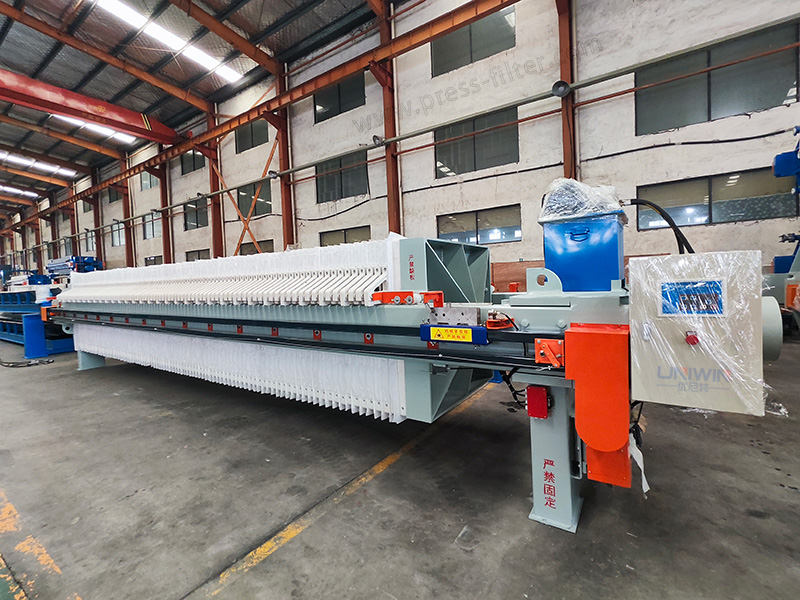
Core Advantages of Large-Scale Filter Presses
Extra-large filtration area and powerful processing capacity
A filtration area of 500 square meters enables a single unit to process massive volumes of slurry, drastically reducing the number of machines and the required footprint, thereby lowering both infrastructure investment and operating costs.
Simultaneous retraction of three filter plates doubles discharge efficiency
Featuring a rapid plate-opening mechanism, the system retracts three filter plates in a single movement; this accelerates discharge speed by approximately three times compared to the traditional method of retracting plates one by one, significantly reducing auxiliary processing time.
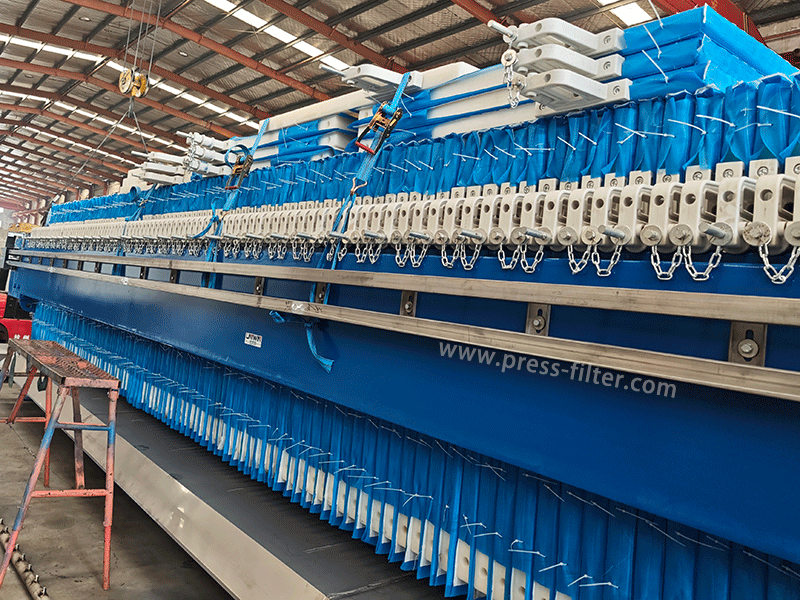
Integrated conveyor system for continuous discharge
The unit features an integrated conveyor belt at the bottom; after the drip tray opens, the filter cakes drop directly onto the belt and are continuously transported to a designated storage area, requiring no manual intervention throughout the process.
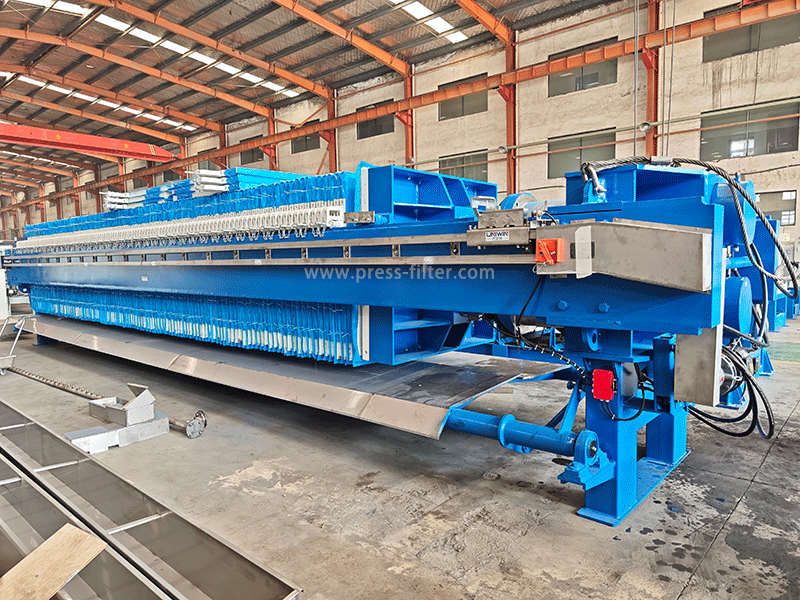
Automatic drip tray discharge with gravity-assisted cake release
Upon completion of the filtration cycle, the drip tray automatically flips open, allowing the filter cakes to detach via gravity; combined with the conveyor system, this enables unmanned discharge.
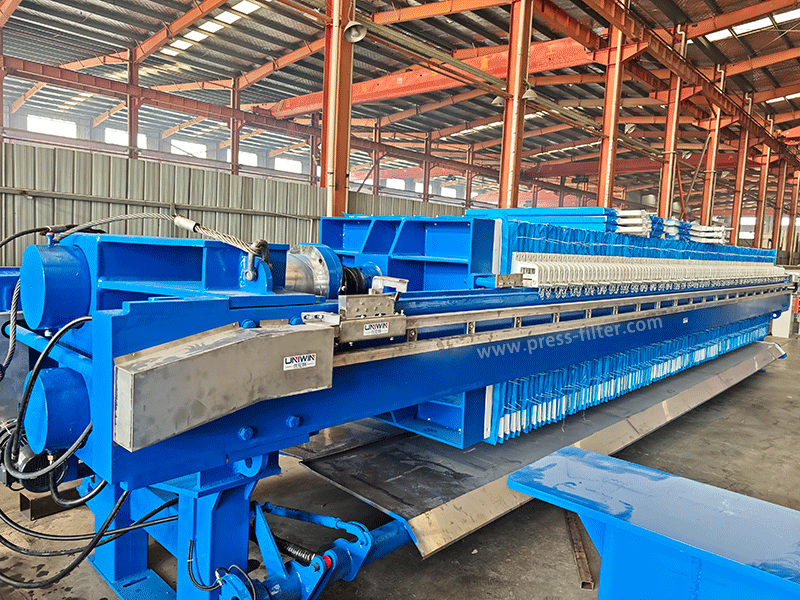
Fully automated process with intelligent control
The entire workflow—including feeding, pressure filtration, plate shifting, drip tray operation, and discharge—is centrally managed by an intelligent PLC control system, enabling one-touch start/stop and remote monitoring.
Typical Application Areas for Large-Scale Filter Presses
- Mining and Mineral Processing: Concentrate dewatering, dry tailings disposal, slurry solid-liquid separation
- Metallurgy and Smelting: Smelting slag filtration, intermediate slurry dewatering, metal recovery
- Chemical Industry: Chemical product separation, catalyst recovery, wastewater treatment
- Environmental Water Treatment: Municipal sludge deep dewatering, industrial wastewater solid-liquid separation
- Food and Pharmaceuticals: Food raw material filtration, pharmaceutical intermediate separation
- Coal Washing and Power Generation: Coal slime water dewatering, fly ash slurry treatment
The mining industry is one of the most critical application sectors for large-scale filter presses. In the mineral processing workflows of metal mines—such as those for nickel, copper, iron, and gold—processes like crushing, grinding, and flotation or leaching generate large volumes of slurry containing fine particles. Efficient solid-liquid separation of this slurry is essential to enable the dewatering and packaging of concentrate products, the safe dry stacking of tailings, and the recycling of process water.
Résumé
Large-scale filter presses are redefining the technical benchmarks for solid-liquid separation equipment in the mining industry, thanks to their massive filtration areas, high-efficiency rapid-opening mechanisms, integrated automatic discharge systems, and intelligent end-to-end control. The 500-square-meter filter press project at a nickel mine in South Africa, as described in this article, has fully demonstrated the engineering value of these core technical advantages.